




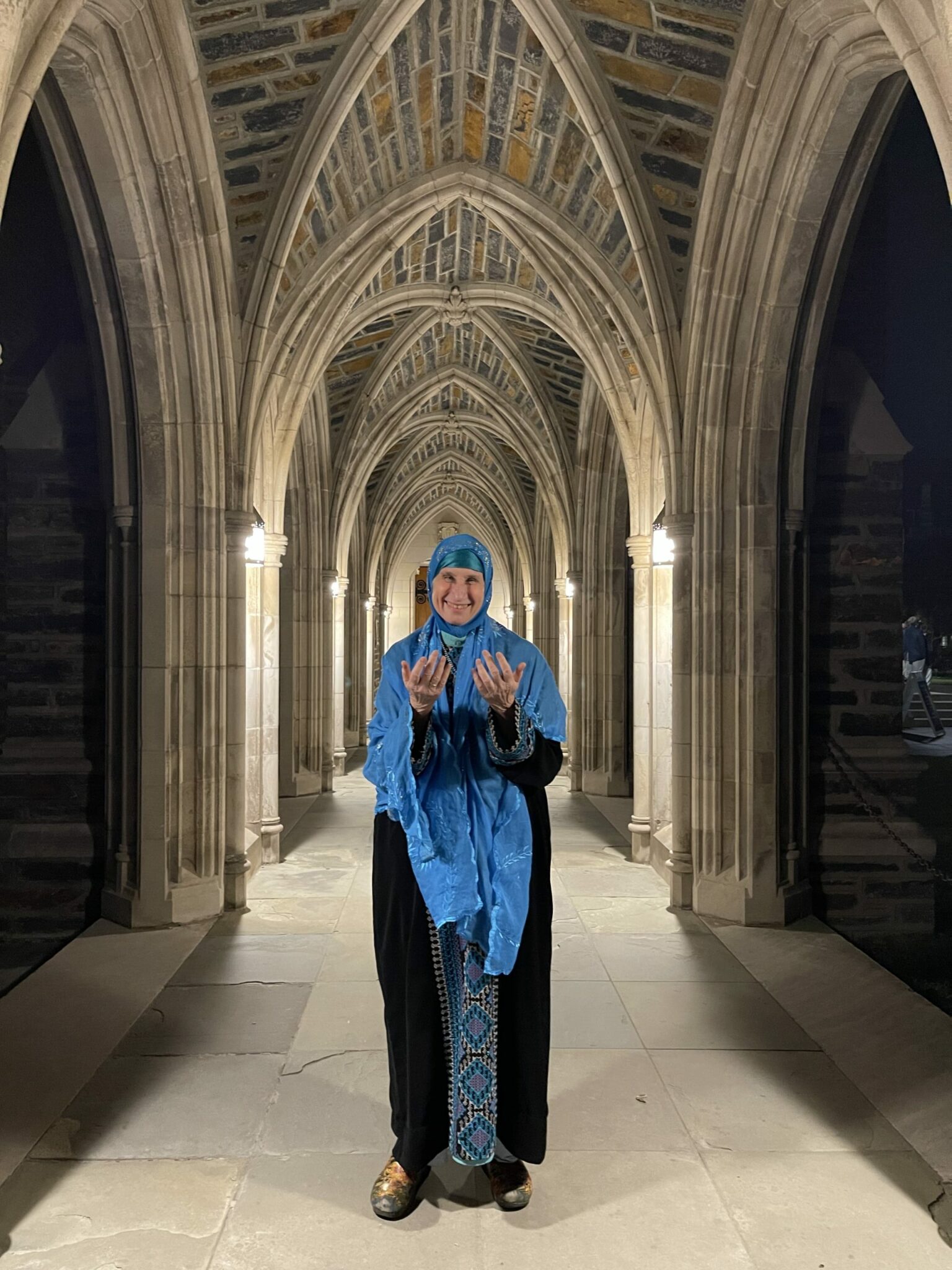
She Left Hollywood at 12 to Find God: Sheikha Maryam Kabeer's Interfaith Journey
By Daisy Khan
A Jewish girl raised in Hollywood and a Sufi spiritual teacher guiding seekers across the globe sound like two entirely different people. They're not. In this episode of Wise Women with Daisy Khan, part of the Muslim Women Project series featuring 100 Muslim women of authority shaping their destiny and society, Dr. Daisy Khan sits down with Sheikha Maryam Kabeer, author of Journey Through 10,000 Veils. Born into a liberal Jewish family in Hollywood, trained in theater as a child, Sheikha Maryam eventually left everything behind to travel the world alone with nothing but a sleeping bag, a journal, and a pair of robes. That journey carried her through Buddhism, Christianity, Hindu teachings, and ultimately into Islam, where she found her life's calling. Her story challenges every assumption about how faith is found and who gets to carry it.
A Hollywood Childhood That Planted Spiritual Seeds
Sheikha Maryam was born in Hollywood and by age five was being trained by well-known Hollywood figures in the art of speaking and connecting with an audience. By twelve, she had joined a theater company, but the stage was never about performance for her. It was about what she could see in the audience: the beauty in their eyes, their faces, and their presence. Her parents were devoted to the civil rights movement. She met Dr. Martin Luther King Jr. as a child, an encounter that shaped her worldview for life.
Then came the moment that changed everything. The assistant director of her theater company gave her a hand-drawn scroll depicting an ancient man with a white beard, wearing a long robe, carrying a lantern and a staff through the mountains. The inscription read: "Seek and the truth shall make you free." When she looked at that image, she didn't see a stranger. She saw herself. At twelve years old, she understood that her destiny was not on a stage in California. It was somewhere out on the road, searching for something most people spend a lifetime avoiding.
No Phone, No Bed, No Plan: A Solo Journey Across Continents
When Sheikha Maryam finally set out, she carried a journal, parchment papers, paints, a sleeping bag, and two robes. No phone, no computer, no bed, no itinerary. Her grandfather had given her and her brothers a small sum of money. While her brothers each bought a car, she bought a ticket to the world.
She boarded the Orient Express, and when she opened her journal, a passage from Rumi was waiting: "When you get on a train, put your baggage down. You can't carry your baggage. You are going to be carried." The message was unmistakable. She was not in control of this journey. Something else was.
What followed were years of being guided by what she describes as divine grace. Children on roadsides in India would point her toward her next destination. Strangers appeared at exactly the right moment with exactly the right message. Traveling through Afghanistan, she heard the call to prayer for the first time. The bus stopped, and everyone stepped out into the desert with their prayer mats tucked under their arms like treasures, laying them out together to pray in the open air. No mosque. No formal gathering. Just people answering a call in the middle of nature. That moment planted the first seed of Islam in her heart, long before she ever learned how to perform the prayers herself.
Walking the Footsteps of Every Prophet
Her spiritual path refused to follow a straight line into any single tradition. A guru in India connected to Ram Dass told her something unexpected: "You must walk in the footsteps of Jesus." That instruction led her to monasteries in Europe, where she lived among women in a Christian community and had deep mystical encounters with the teachings of Jesus. She was eventually baptized in the snow on Mont Blanc.
Her journey then brought her to Jerusalem, where she joined a group interviewing Jews, Christians, and Muslims for a book about the city's spiritual significance. She was led to the tomb of Abraham, where she felt the unity of all faiths under one divine tent. That convergence deepened when she was guided to a 135-year-old Palestinian sheikh living near Hebron, who had been waiting for her. During her time with his community, she learned to pray, participated in zikr, and experienced a mystical 40-day retreat in a dream that led her directly into Islam. It was not a conversion. It was a homecoming.
One of the most striking moments came at the gates of Masjid Al-Aqsa. The guards told her only Muslims could enter. She said she was Muslim. They told her to recite the Quran. She did, having learned from her sheikh. Overwhelmed, the guards took her to the police station on the Mount of Olives. The police chief jumped out of his seat and said, "That is Maryam. Take her to pray." She entered the empty mosque, filled with light, and prayed on the Imam's prayer mat, standing in the very place where Prophet Muhammad is believed to have led all the prophets in prayer together.
The Transmission That Anchored Everything
The final chapter began when she arrived at the Bawa Muhaiyaddeen Fellowship in Philadelphia, across the street from where she has lived for 35 years. Bawa was a spiritual master from Sri Lanka who didn't speak English, yet his transmission reached people at a level beyond language. She was supposed to interview him, but he had other plans. He told her to abandon the book about Jerusalem, saying peace could not be achieved in the physical city. Instead, she must make peace in Jerusalem within her own heart, "and then the bees will come to get the honey."
Under his guidance, formal Islamic practice took root in the community organically. Sheikha Maryam and her future husband became the first to lead prayers and teach Arabic. A mosque was built. But Bawa's teaching was never about imposing structure. His message, repeated endlessly, was: "You must love all lives as your own."
Today, Sheikha Maryam carries that transmission forward. When people tell her she's beautiful, her response is always the same: "It's not me. You're looking into a mirror and seeing the beauty within yourself." Her message to anyone searching for spiritual direction is direct: the journey doesn't require a plane ticket or a dramatic departure. It requires an open heart. As she puts it: "Be blessed, not stressed, distressed, or depressed." Return to the source of blessing within your heart whenever the world pulls you into agitation, and the grace will reestablish itself.
Pick up her book Journey Through 10,000 Veils to go deeper into her story, visit her at www.uniteinthelight.net, and subscribe to Wise Women with Daisy Khan wherever you get your podcasts for more conversations with women redefining spiritual leadership.
This episode is part of the Muslim Women Project on Wise Women with Daisy Khan, a series featuring 100 Muslim women of authority shaping their destiny, community, and society at large.
#WISEWomenwithDaisyKhan #WISEWomen #SheikhaMaryam #JourneyThrough10000Veils #SpiritualJourney #Sufism #IslamicSpirituality #UnityOfFaiths #MasjidAlAqsa #Jerusalem #DivineGrace #InnerTransformation #SeekTheTruth #UniteInTheLight
About : Sheikha Maryam Kabeer
Sheikha Maryam was born in a liberal Jewish family in Hollywood, California. She was an actress at the age of five and was acting in a Theatre Company when she was twelve years old, when she was given a painted scroll of an ancient wanderer, upon which were inscribed the words: “Seek and The Truth Shall Make You Free.” This message galvanized her soul and determined the course of her life. In search of the liberating truth, she was led to live in India and Nepal, and in monasteries in Europe and then guided to embrace Islam at the hands of an ancient Sufi Master a few minutes away from the tomb of the Prophet Abraham (a.s.).
Connect with Dr. Daisy Khan:
Websites:
Follow WISE Women with Daisy Khan:
Connect with Imam Sheikha Maryam Kabeer:
WISE Women with Daisy Khan
Where Muslim voices rise, bridges are built, and history's unsung heroines reclaim their light.
WISE Women with Daisy Khan gives voice to Muslims sharing their experiences with anti-Muslim bias, educates non-Muslims to become upstanders against discrimination, and spotlights extraordinary women throughout history whose contributions have been erased. We reclaim faith as a force for good while building bridges between East and West, transforming fear into understanding, one conversation at a time.
We challenge disinformation with knowledge and empathy, confronting the weaponization of religion for political gain. This isn't just another podcast. It's a bridge between communities taught to fear each other, opening hearts and minds to build the understanding our divided world needs.
Welcome to WISE Women. Where wisdom meets courage, and voices become bridges.
News [Source: CBS Evening News]
A man sent a hateful message to a Muslim candidate. He responded with a call for help, article by Steve Hartman
https://www.cbsnews.com/news/a-man-sent-a-hateful-message-to-a-muslim-candidate-he-responded-with-a-call-to-help/
Comments