




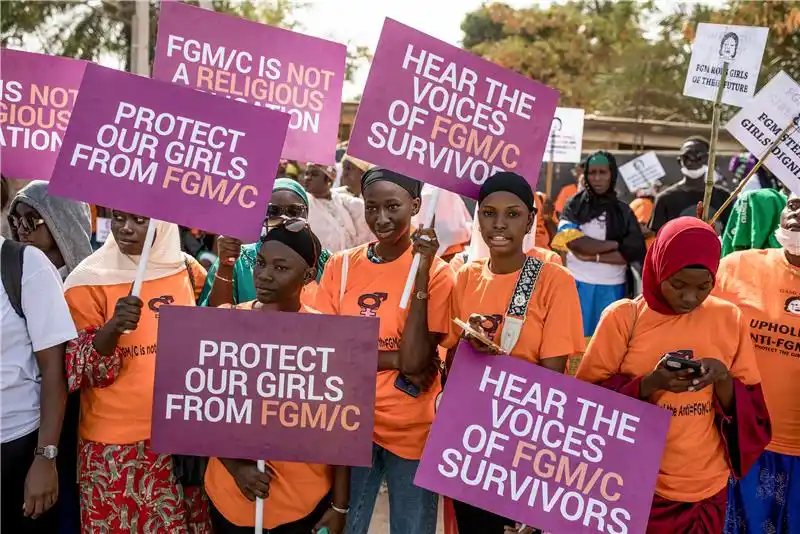
When Culture Wears a Veil of Faith, Exposing the Truth About FGM
By Daisy Khan
A man in a Manhattan church raised his hand and sliced through a polite interfaith script with one question. Why does Islam allow female genital mutilation while girls bleed and scream around the world? Daisy Khan, a Muslim woman steeped in interfaith dialogue, froze. She had never heard the term. The gap between what many Americans assumed about Muslim women and what she knew from her own life could not have been wider.
That moment pushed her into clinics, villages, and conference halls. She uncovered a painful reality. A practice older than every major religion had wrapped itself in Islamic words and symbols, then walked into mosques and homes as if it were a command from God.
In this episode of WISE Women with Daisy Khan, activist and survivor Mariya Taher joins Daisy to confront one of the most stubborn myths about Muslim women and faith. Together, they reveal how culture disguises itself as religion, what Islamic sources actually teach, and how survivors are changing law and community norms.
When Culture Puts On a Religious Mask
If a Muslim woman immersed in scholarship and interfaith work had never heard of FGM, how could it be required by Islam. That question took Daisy to Egypt, a Muslim majority country where FGM was banned in law yet continued in secret.
In cramped rooms and backstreet clinics, she watched practitioners cut little girls. When she asked why, their answer came quickly. They believed it was Islamic. Not cultural. Not optional. Obligatory. When she demanded a Quranic verse, none appeared. The text was silent on FGM. The blades were not.
A familiar pattern emerged. When culture is never questioned, it learns to speak in religious language and turns harm into duty. Evidence of genital cutting appears on ancient Egyptian mummies long before the Quran, the Bible, or any other scripture. Today, the practice crosses religious lines, carried by some Muslims, Christians, Jews, and traditional communities.
Islamic ethics point in a different direction. The human body is understood as an amanah, a sacred trust from God. No one has the right to damage that trust without real medical need and consent. Cutting healthy genital tissue of girls, usually between four and ten years old, destroys that trust and makes consent impossible.
Sacred Trust, Broken Bodies
The more closely Daisy looked at Islamic sources, the sharper the conflict became. The Quran warns against obeying blind tradition when it contradicts divine guidance. It teaches that God created human beings in the best form, then warns that humans destroy themselves with their own hands. FGM does both. It clings to inherited custom and wounds the very body God calls a trust.
The damage runs through a woman’s entire life. FGM reshapes her relationship with her body, fractures intimacy, and threatens marital trust. A space meant for comfort and pleasure becomes a source of fear and pain. Claims that this harm protects morality twist Islamic teaching. Sexual ethics in Islam bind both men and women. Violence is never an acceptable tool of control.
Efforts to link FGM to hadith fall apart under close reading. Reports that seem to endorse a so called “sunna circumcision” have long been graded weak by many scholars. There is no solid evidence that women in the Prophet’s household experienced FGM. Institutions such as Al Azhar have warned that using the phrase “sunna circumcision” for women is a way to deceive believers into thinking the practice is Islamic.
When Islamic Law Rejects Harm
Common comparisons to male circumcision ignore fundamental differences. FGM removes or damages functional, sensitive tissue with lifelong consequences for health and pleasure. Male circumcision does not share that risk profile. Egyptian scholar Dr Suad Saleh has argued that FGM is closer to the pre Islamic practice of burying infant girls alive than to any legitimate rite. Islam came to end such practices, not to bless them.
Set beside the higher objectives of Islamic law, the maqasid al shariah, the verdict is clear:
It harms life by increasing maternal and infant deaths
It harms mind through trauma and anxiety
It harms family by destroying intimacy
It harms dignity through chronic pain and humiliation
It can even harm faith when it interferes with worship
Across 1,400 years of scholarship, there has never been unanimous agreement that FGM is required. One school historically tolerated a minor form, but that view formed before modern medical knowledge. Today, religious reasoning and medical evidence align. FGM is not an Islamic duty.
A Survivor Turns Silence Into Policy Change
While Daisy worked with scholars and imams, Mariya Taher was walking a survivor’s path in the United States. As a teenager, she began to recognize that what had happened to her had a name. Female genital cutting. In college and graduate school, she researched it further, especially in her own South Asian Dawoodi Bohra community.
She wanted to know why FGM continued even where it was illegal and what help existed for survivors. At first, she wrote anonymously, aware of the risk of challenging something guarded by elders and presented as a sign of belonging. Over time, anonymous articles became named testimony. A national television segment marked the point where she stepped forward with her real name, insisting the public see that survivors live in American suburbs as well as in distant villages.
In Massachusetts, Mariya joined a coalition that pushed for a holistic state law. They demanded more than criminal penalties. They argued for education, outreach, and civil remedies for survivors. After years of lobbying and coalition work, the law passed in 2020.
Because it included an education mandate, her organization Sahiyo received support to raise awareness across the state. A decade after first naming her story, she was helping shape how health systems, agencies, and communities respond to FGM.
Breaking the Story That Everyone Wants It
Law alone cannot uproot a norm held in place by silence and fear. In many communities, FGM is framed as a rite of passage or a condition for marriage. Parents and especially grandmothers may insist on it less from cruelty and more from terror that uncut girls will be rejected.
Sahiyo’s research in one Dawoodi Bohra setting revealed the hidden contradiction. Around 80 percent of respondents had undergone FGM. More than 80 percent did not want it to continue. Many believed they were in the minority. This pattern, known as pluralistic ignorance, keeps harmful customs alive. People obey rules they secretly reject because they think everyone else still believes.
To confront that illusion, Sahiyo created storytelling spaces where survivors could speak and listen to each other. In digital storytelling workshops, participants shaped short visual narratives about their experiences, their medical care, or their relationships with mothers and grandmothers. The goal was connection and truth, not spectacle.
These stories now serve as tools for training health providers, educating communities, and supporting healing. Survivors who once felt alone find each other and form bonds that help them resist pressure. Some families use these conversations to protect their daughters, ending a cycle that lasted generations.
When Minds Shift, Laws Hold
Work in Gambia mirrors this pattern on a national scale. Local activists and religious leaders, supported by research such as the Global Muslim Women’s Shura Council position paper that Daisy convened, secured fatwas against FGM and a national ban. When an imam later tried to overturn that ban, educated communities defended it. The law held because hearts and minds had shifted.
The story of FGM in Muslim communities is not a story of Islam demanding harm. It is a story of culture misusing Islam’s name, and of Muslim women, survivors, and scholars refusing that misuse.
Faith claimed as a force for justice becomes an ally of human rights. The Quran’s teaching that the body is a trust, the prophetic rule that there should be no harm and no reciprocating harm, and the goals of Shariah all pull in the same direction. FGM cannot be worship when it destroys what God commands believers to protect.
Listen to WISE Women with Daisy Khan because every story matters. The qualities that sustain us through difficulty often become the very gifts we offer to the world. Share this episode with someone who influences your community. Use it to start a real conversation about faith, harm, and the responsibility to protect girls. For more inspiring stories and discussion, like, follow, and connect with Dr Daisy Khan for resources and subscribe, rate, and review to help more listeners find this message.
#WISEWomenwithDaisyKhan #WISEWomen #DaisyKhan #MariyaTaher #FGMIsUnIslamic #EndFGM #StopFGM #FGMAwareness #MuslimWomen #FaithAndJustice #IslamAndHumanRights #GenderJustice #EndGenderBasedViolence #GirlsRights #SurvivorVoices #BreakTheSilence #MuslimAmerican #FaithAndActivism #InterfaithDialogue #SocialJustice
Connect with Dr. Daisy Khan:
Websites:
Follow WISE Women with Daisy Khan:
Instagram: https://www.instagram.com/WISEwomenwithdaisykhan/
Facebook: https://www.facebook.com/profile.php?id=61576656401275
Connect with Mariya Taher:
Mariya Taher , MSW, MFA, is an award-winning social activist and writer with over fifteen years dedicated to ending gender-based violence. In 2015, she co-founded Sahiyo, a leading transnational organization committed to empowering communities to end female genital cutting (FGM/C). Her pioneering use of storytelling to end FGM/C earned her the Human Rights Storytellers Award, and her exceptional leadership was recognized with the 2023 L’Oreal Paris USA Women of Worth award. She is also an extensive writer with contributions to NPR’s Code Switch, HuffPost, and more. When she isn’t engaged in advocacy work, she can be found at the yoga studio being a certified yoga teacher or throwing clay at her community-pottery studio.
WISE Women with Daisy Khan
Where Muslim voices rise, bridges are built, and history's unsung heroines reclaim their light.
WISE Women with Daisy Khan gives voice to Muslims sharing their experiences with anti-Muslim bias, educates non-Muslims to become upstanders against discrimination, and spotlights extraordinary women throughout history whose contributions have been erased. We reclaim faith as a force for good while building bridges between East and West, transforming fear into understanding, one conversation at a time.
We challenge disinformation with knowledge and empathy, confronting the weaponization of religion for political gain. This isn't just another podcast. It's a bridge between communities taught to fear each other, opening hearts and minds to build the understanding our divided world needs.
Welcome to WISE Women. Where wisdom meets courage, and voices become bridges.
News [Source: CBS Evening News]
A man sent a hateful message to a Muslim candidate. He responded with a call for help, article by Steve Hartman
https://www.cbsnews.com/news/a-man-sent-a-hateful-message-to-a-muslim-candidate-he-responded-with-a-call-to-help/
Comments