




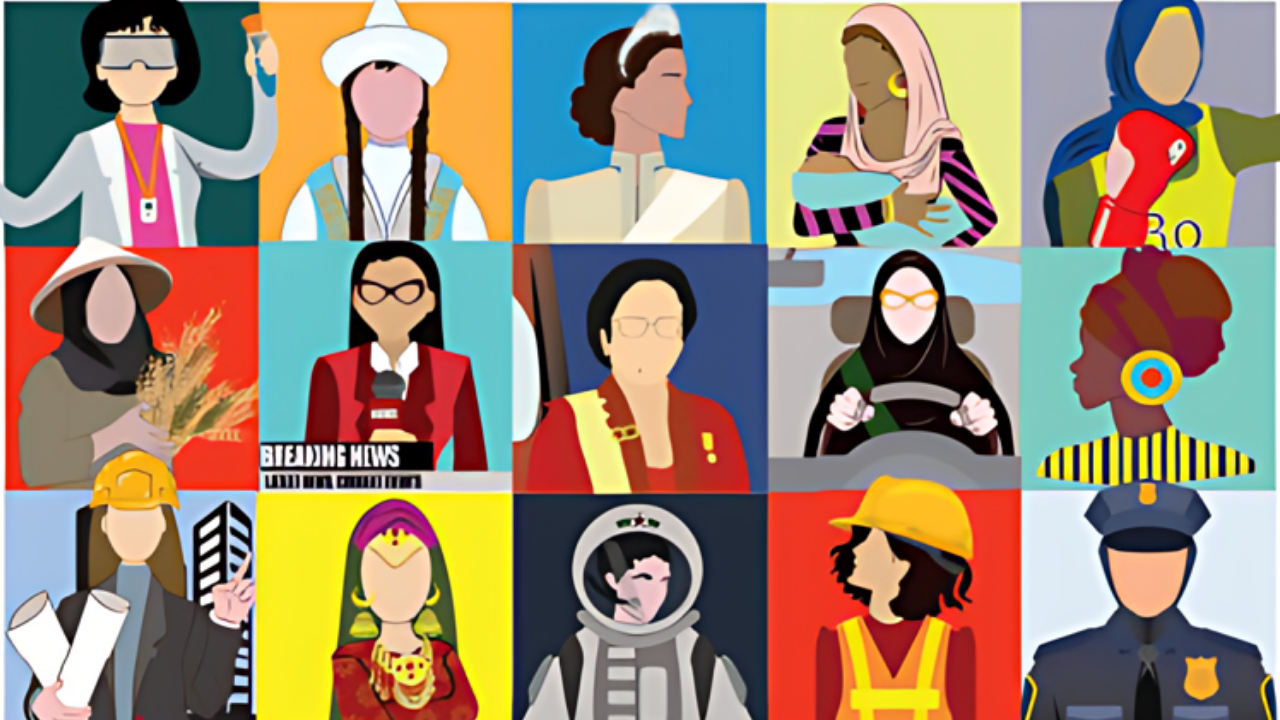
Who Erased Muslim Women From History? The Quran Told a Different Story All Along
By Daisy Khan
Muslim women were erased from history not by scripture but by the men who interpreted it. On this International Women's Day episode of WISE Women with Daisy Khan, Professor Asma Afsaruddin sits down with Daisy Khan to trace exactly when and why that erasure happened. Professor Afsaruddin is a scholar of Middle Eastern languages and cultures at Indiana University Bloomington, a Johns Hopkins PhD, and the editor of the Oxford Handbook of Islam and Women.
She has spent decades reading the original Arabic sources that most Muslims never access. What she found dismantles the assumption that Islam was always a patriarchal system. The earliest centuries of Islamic scholarship contained a gender-egalitarian worldview that would be almost unrecognizable to Muslims reading commentaries written after the 14th century.
Daisy Khan opens the episode with a sharp framing. She turns to the Quran and identifies two models of leadership. The Pharaoh, arrogant and violent, targets women and children to protect his dominance. And Queen of Sheba, Al Malikah Bilqees, who consults her advisors, chooses negotiation over war, and prioritizes her people's welfare. The Quran presents both without a single mention of gender determining leadership quality. Character determines it. Khan argues that when men exploit women and girls with zero consequences, they resemble the Pharaoh more than they realize. And when institutions protect abusers instead of victims, they repeat the same ancient pattern that the Quran itself warned against. Khan also points to the Quran's broader track record. God chose many women to lead important missions, and many of these women were the unexpected and the overlooked. Single women. Widowed women. Separated women. Childless women. Women who rescued prophets, advised rulers, taught scholars, debated publicly, and stood in battle when necessary. Their contributions were central. And yet, over time, those stories got buried.
The Rib Story That Was Never in the Quran
Professor Afsaruddin's journey began at Oberlin College, where she fell in love with Arabic and realized that reading Islamic texts in their original form revealed a different world than translated commentaries offered. If only male scholars had engaged with the text for centuries, then every surviving interpretation carried a built-in bias. She went back to the earliest exegetical literature and found that gender egalitarianism was not fringe in early Islam. It was mainstream. The Quran describes human creation from a single soul, Nafs Waheda. That soul is not gendered. Male and female were created simultaneously and equally, with no priority given in the order of creation. The story of woman being made from Adam's rib belongs to Genesis. It was borrowed into Islamic literature through questionable hadith and uncritical exegesis, then repeated across so many centuries that it became accepted as Islamic belief. By the Mamluk period in the 14th and 15th centuries, nobody questioned it anymore. It had become canonical. Professor Afsaruddin points out that some early scholars did push back, asking where this story actually appears in the Quran. It doesn't. It never did.
The same pattern of textual distortion applies to the Arabic word Qanitat, which appears in Quran 4:34. In every other instance across the Quran, this word means devoutness and obedience to God. In Quran 33:35, the same term is applied equally to devout men and devout women, clearly referring to devotion to God. But male commentators reading 4:34 removed God as the object of devotion and quietly substituted "husband." Professor Afsaruddin calls this an impossible reading. The Quran never uses this term for obedience to another human being, with one exception referring to the Prophet. That single linguistic swap stripped Muslim women of independent moral agency for centuries. She also dissects the word Daraja, meaning degree or rank, which scholars like Ibn Kathir read as absolute male superiority. But the Quran uses Daraja in multiple contexts to describe relative, conditional distinctions tied to function, not ontological hierarchy. It referred specifically to men's role as economic providers, a function that evaporates when women also earn.
When Baghdad Fell, Women Paid the Price
Professor Afsaruddin pinpoints the Mongol destruction of Baghdad in 1258 and the Crusader campaigns as the catalysts that rewired Islamic gender scholarship. When men could not control the external chaos invading their societies, they turned inward. Women became the variable to restrict. Ibn Taymiyyah, writing during this era, argued that women entering the public sphere was itself a source of disorder. Mamluk-era scholars reinforced the message that women should confine themselves to the domestic realm as a stabilizing force against upheaval. Professor Afsaruddin traces how biographical dictionaries changed across centuries. Umm Amara, a woman companion who fought on the battlefield and received direct praise from the Prophet for her valor, had her story progressively shrunk. By the time Ibn Hajar compiled his biographical dictionary, her contribution was reduced to a short section.
When external threats feel uncontrollable, restrictions on women increase
Scholars and politicians frame women's domesticity as a return to "core values"
Historical women leaders get quietly edited out of the record
The cycle repeats until someone returns to the original sources
Professor Afsaruddin does not leave this observation in the medieval period. She draws a direct parallel to Afghanistan, where the desire to resist imperial influence has produced the most extreme restrictions on women in the modern world. Then she extends it to the United States, where a perceived siege mentality around immigration and cultural change is eroding women's rights in real time. Daisy Khan connects the dots. The mechanism is always identical. Fear of losing control produces the reflex to cage women. It happened after the Mongol invasions. It is happening in Kabul. It is happening in American state legislatures.
The First Mayors of Mecca and Medina Were Women
The episode's most striking evidence comes in the form of two names that most Muslims have never heard. Shifa bint Abdullah served as market inspector of Medina. Samra bint Nuhayik served the same role in Mecca. Professor Afsaruddin compares these positions to a modern-day mayor, responsible for law and order in the two most important cities in Islamic history. Samra bint Nuhayik patrolled the marketplaces of Mecca with a whip in her hand, looking for anyone who violated trade rules. Omar, the second Caliph, appointed Shifa bint Abdullah. The Prophet himself may have appointed Samra bint Nuhayik, which would make the placement of women in public office part of the Sunnah. Nobody at the time questioned these appointments. Professor Afsaruddin asks the question that later scholars never wanted to face. If the Prophet saw nothing wrong with women holding public authority, then why did scholars like Al-Mawardi later declare women unfit for public office?
She also highlights Umm Waraqa, whom the Prophet appointed as imam of her mixed household of men and women because she was the most learned in the Quran among them. Daisy Khan calls this meritocracy in action and refers to the Prophet as a seventh-century feminist. The tools for correcting the record already exist inside the same Arabic texts that scholars have been citing selectively for generations. Professor Afsaruddin and her colleagues are not rewriting scripture. They are removing the additions that men attached to it and letting the original text speak again. The question was never about what the Quran says about women. It always said it clearly. The question is about who was allowed to read it and what they chose to leave out.
This episode is part of The Muslim Women Project on WISE Women with Daisy Khan, featuring 100 Muslim women of authority shaping their destiny, community, and society at large. Listen to the full conversation wherever you get your podcasts.
#WISEWomenwithDaisyKhan #WISEWomen #ProfessorAsmaAfsaruddin #WhoErasedMuslimWomen #IslamAndWomen #QuranAndGender #MuslimWomenInHistory #GenderEqualityInIslam #WomensRightsInIslam #InternationalWomensDay #OxfordHandbook #IslamicFeminism #MuslimWomenProject #DaisyKhan #ReclaimTheNarrative #PatriarchyIsNotIslam
About : Asma Afsaruddin
Professor Asma Afsaruddin is the Class of 1950 Herman B. Wells Endowed Professor of Middle Eastern Languages and Cultures at Indiana University Bloomington. She holds a PhD from Johns Hopkins University and has previously taught at Harvard and Notre Dame. She is the author or editor of nine books, including the Oxford Handbook of Islam and Women. She was inducted into the Johns Hopkins Society of Scholars in 2019 and named a Carnegie Scholar in 2005. Her research focuses on Quranic interpretation, gender in Islam, and Islamic political thought.
Connect with Dr. Daisy Khan:
Websites:
Follow WISE Women with Daisy Khan:
Connect with Asma Afsaruddin:
Email: aafsarud@iu.edu
WISE Women with Daisy Khan
Where Muslim voices rise, bridges are built, and history's unsung heroines reclaim their light.
WISE Women with Daisy Khan gives voice to Muslims sharing their experiences with anti-Muslim bias, educates non-Muslims to become upstanders against discrimination, and spotlights extraordinary women throughout history whose contributions have been erased. We reclaim faith as a force for good while building bridges between East and West, transforming fear into understanding, one conversation at a time.
We challenge disinformation with knowledge and empathy, confronting the weaponization of religion for political gain. This isn't just another podcast. It's a bridge between communities taught to fear each other, opening hearts and minds to build the understanding our divided world needs.
Welcome to WISE Women. Where wisdom meets courage, and voices become bridges.
News [Source: CBS Evening News]
A man sent a hateful message to a Muslim candidate. He responded with a call for help, article by Steve Hartman
https://www.cbsnews.com/news/a-man-sent-a-hateful-message-to-a-muslim-candidate-he-responded-with-a-call-to-help/
Comments